
The Forgotten Ball Player

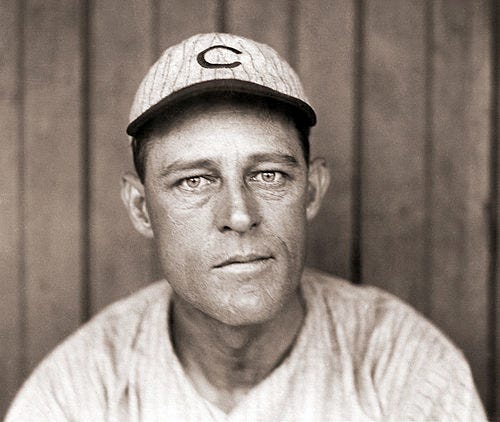
Every year, when baseball season starts, I think about Harry Steinfeldt.
“Of course!” you’re thinking. “Harry Steinfeldt!”
For the vast majority of you who have no idea who he was, Harry Steinfeldt was the third baseman for the Chicago Cubs in 1910. Actually, he played third base for them a few other years, too, but 1910 is significant because it was the year the most famous infield in baseball history was immortalized in verse by Franklin Pierce Adams:
These are saddest of possible words:
“Tinker to Evers to Chance.”
Trio of bear cubs, fleeter than birds,
Tinker and Evers and Chance.
Ruthlessly pricking our gonfalon bubble,
Making a Giant hit into a double—
Words that are heavy with nothing but trouble:
“Tinker to Evers to Chance.”
You see, Joe Tinker played shortstop, Johnny Evers played second base, and Frank Chance played first base for the 1910 Cubs. Almost everyone who follows baseball has heard of this famous double-play combination. And that makes Harry Steinfeldt the answer to what may be the ultimate baseball trivia question: Who played third base for the 1910 Cubs?
That’s how I first learned about Harry. Someone asked me that question once, and even told me the answer, and then I promptly forgot it. Then I asked someone else the question, didn’t know the answer, so we looked it up in the baseball almanac. There he was, Harry Steinfeldt. By all accounts a pretty good ball player with a cannon for a throwing arm. He batted .267 lifetime, hit .327 in 1906 (second in the National League), led the league in hits and RBIs that same year, and played in four World Series with the Cubs. He had a lifetime fielding percentage of .926 and was considered the best fielding third baseman of his day. For comparison, Joe Tinker (who is in the Baseball Hall of Fame along with Johnny Evers and Frank Chance) hit .262 lifetime and had a fielding percentage of .938.
So why was Harry Steinfeldt relegated to being the player no one remembers?
The obvious answer is that third basemen aren’t involved in nearly as many double plays as shortstops and second basemen, let alone first basemen. But Harry was in a lot of double plays playing the hot corner, finishing in the top five for double plays turned by third basemen for ten years. Was there something about his personality? There’s no accounts of misbehavior on his part. In contrast, Johnny Evers was nicknamed “The Crab” both because of his fielding style and for his unpleasant disposition, while Frank Chance was supposedly as nasty or nastier than the infamous Ty Cobb. Sure, Harry’s batting fell off a bit after the 1906 season and he only played for 13 years total, but it seems he hardly deserves the obscurity to which he seems to have been relegated.
In a lot of ways Harry Steinfeldt represents the role luck plays in baseball, and also in who becomes famous and who doesn’t. So much of baseball is about luck. After all, when only 25 hits in 500 at-bats separates a great season from a mediocre one it’s hard to think success is entirely due to ability alone. Sure, the real greats, the Babe Ruths and Hank Aarons, show they can do it consistently. But even an average ball player could have a string of seasons where everything breaks his way and suddenly they’re a star!
That never happened for Harry Steinfeldt. He had his career year at the plate in 1906 and then was just a solid workhorse. He’s the everyman, the guy who came to work every day and did his job but never got any fame or recognition for it. The Cubs put him on waivers after 1910 and he played one more season with the Boston Rustlers (the next year they changed their name to the Boston Braves). Harry died in Kentucky in 1914.
So why is Harry Steinfeldt the player no one remembers? I don’t really know the answer to that question, but I do know that, to me at least, Harry Steinfeldt represents the forgotten man. He’s like the rest of us, who may come in to contact with fame or glory, may even play some role in it, but are somehow overlooked by posterity.
So here’s to Harry Steinfeldt! You’re remembered by some, which is more than most of us will be.
I had a friend who was a phenomenal athlete. Was a starter in every team sport in high school. Ended up drafted by the A's and ultimately played for the Yankees, Reds, Indians, and Cubs. Even though he was a top AAA player, he was a catcher, and every team he ended up on had a future HOF or current All-Star catcher. His chance finally came up as the backup with the Reds when the starting catcher was injured. He was set to replace him for the whole season. Then there was a strike, and the season was halted. The next year, he was with the Cubs and got injured, and they brought up a young guy from Triple A, and my friend never played again in the majors. Luck and timing are big factors as you note so well.
History is full of those people. Cool write-up!
Also interesting for someone like me who knows next to nothing about baseball.